Running two or more optical stores is a different problem from running one. The moment you open a second branch, you need a single, live view of stock, sales, and customers across locations — otherwise you are calling each shop for numbers, double-counting inventory, and consolidating GST by hand. Multi-store optical software solves this by putting every branch on one cloud platform with a shared catalogue and head-office reporting. Here is what optical chains and franchises should look for in 2026.
Why Multi-Store Optical Shops Need Centralised Software
Single-shop tools break down as soon as you have more than one location. Common pain points for a growing optical chain:
- No live view of which branch is selling what — the owner finds out days later.
- Stock is stranded: one branch is out of a popular frame while another has it sitting idle.
- Each shop keeps its own customer list, so a customer’s history is invisible at other branches.
- Prices and offers drift apart between locations.
- Month-end GST and sales consolidation is a manual spreadsheet exercise.
Centralised, cloud-based optical software fixes all of these by design.
Key Features for Optical Chains & Franchises
Centralised Product & Price Master
One catalogue of frames, lenses, and contact lenses — with HSN codes and prices — is maintained centrally and shared by every branch. New products and price changes apply everywhere at once, so the brand stays consistent and no branch sells at the wrong price.
Inter-Store Stock Transfers
Move stock between branches with a tracked transfer order: the sending store dispatches, the receiving store confirms by scanning, and both inventories update in real time with in-transit stock shown separately. This lets a chain rebalance fast-moving frames and specific lens powers to where demand is, without losing track. (More on how this works in our inventory management guide.)
Consolidated GST & Sales Reporting
See group-level performance and drill down to any single store. OptoSoft keeps each branch’s GST figures separate (per GSTIN) while giving the owner consolidated sales, purchase, and profit reports across the network — eliminating manual month-end consolidation.
Branch-Wise User Roles & Permissions
Each staff member and franchisee sees only what they should: their own branch’s billing and stock, while head office sees everything. Role-based access keeps sensitive data — margins, purchase costs, group reports — restricted to owners and managers.
Central CRM Across Branches
A shared customer database means a customer who bought spectacles at one branch can be served, with full prescription history, at another. Automated WhatsApp/SMS recalls and contact-lens refill reminders run across the whole network. See our optical CRM guide for how retention automation works.
Real-Time Head-Office Dashboards
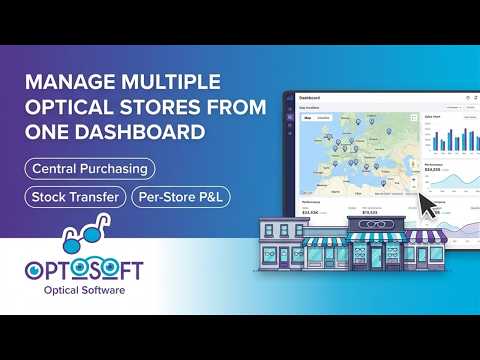
Live dashboards show today’s sales, collections, and stock position for every store from a single login — on a browser or the Android app. The owner monitors the whole chain from anywhere instead of visiting or phoning each shop.
Cloud vs On-Premise for Optical Chains
For multiple locations, cloud is the practical choice. On-premise systems trap each branch’s data on a local PC, requiring manual syncing and giving the owner no live cross-branch view. Cloud-based optical software like OptoSoft keeps every store on one shared database, updates instantly across locations, needs no per-branch server, and lets the owner work from anywhere. It also keeps billing usable during brief connectivity drops and syncs when the connection returns.
Optical Franchise Management
Franchise networks add a layer: the brand owner needs control of catalogue and pricing, while each franchisee runs their own outlet. Multi-store optical software supports this with a central master pushed to all outlets, branch-isolated logins and reporting per franchisee, and head-office visibility across the network. The result is brand consistency on price and product with independent day-to-day operation per franchise.
Multi-Store Optical Software Pricing
The pricing model matters as much as the features when you have several stores. OptoSoft uses a simple per-store model:
- ₹6,000 per store per year in India — unlimited users per store.
- US$399 per store per year internationally — same feature set.
- No per-user fees and no per-module add-ons, so cost stays predictable as you add branches.
A three-branch chain simply pays for three stores. Compare this with enterprise systems that charge by user or module, where costs climb steeply with each location. View full plans on the pricing page or the complete features list.
Rolling Out Multi-Store Software — 4 Steps
- Set up the central master. Build one product, price, and HSN catalogue, then make it available to all branches.
- Onboard each branch. Import each store’s opening stock, set its invoice series and GSTIN, and create branch user logins with the right roles.
- Connect customers & CRM. Merge or import customer and prescription records so history is shared, and switch on automated recalls and refill reminders network-wide.
- Go live with head-office reporting. Train managers on the consolidated dashboards, then run the chain from one live view.
See OptoSoft in Action
Related Reading
- How to Choose an Optical Shop Management System in India (2026) — the full buyer’s guide to billing, CRM, inventory, and POS.
- Optical Inventory Management Software 2026 — barcode stock control and inter-store transfers in detail.
- Optical CRM Software Price in India 2026 — central CRM and automated retention across branches.
- OptoSoft Features Overview — full multi-store and franchise management documentation.
- OptoSoft Pricing Plans — multi-store management is included with no per-store license inflation, from ₹6,000/year.
Frequently Asked Questions — Multi-Store Optical Software
Can one optical software manage multiple stores from a single login?
Yes. OptoSoft is cloud-based, so a head office can see every branch from one login in real time: live sales, stock, and customers across all stores. Each branch operates its own counter and invoice series, while the owner gets consolidated dashboards and reports. There is no need to visit or call each shop to know how it is performing.
How do inter-store stock transfers work in optical chain software?
The transferring branch or head office raises a stock transfer order, the receiving branch confirms receipt by scanning the items, and both stores’ inventory updates in real time. Stock in transit is tracked as a separate status so it does not show as available at either location until confirmed. This lets a chain move fast-moving frames or specific lens powers to the branch that needs them without losing track of stock.
Does multi-store optical software give consolidated GST and sales reports?
Yes. OptoSoft consolidates sales, purchases, and GST data across all branches while still keeping each branch’s figures separate. You can view group-level performance and drill down to a single store, and export GSTR-ready registers per GSTIN. This removes the manual spreadsheet consolidation that multi-store optical owners otherwise do every month.
Is OptoSoft suitable for optical franchises?
Yes. For franchise models, OptoSoft supports a central product and price master pushed to all outlets, branch-wise user roles so each franchisee sees only their store, and head-office visibility across the network. The brand stays consistent on pricing and catalogue while each franchise runs day-to-day billing independently.
How is multi-store optical software priced?
OptoSoft is priced per store: ₹6,000 per store per year in India and USD 399 per store per year internationally, each with unlimited users. A three-branch chain in India therefore pays for three stores with no per-user charges. This per-store model keeps cost predictable as you add outlets, unlike enterprise systems that price by user or module.