An optical POS (point-of-sale) system is software that runs the front counter of an optical shop — it combines GST billing, prescription (Rx) lookup, barcode inventory, customer records and payment collection in one screen, so an optician can bill a customer, pull their spectacle or contact-lens power, check stock and take payment in a single workflow. Unlike a generic retail till, an optical POS understands lens powers and links every sale to the customer’s prescription. This guide explains what it does, why optical shops need one, and what it costs in India in 2026.
What Is an Optical POS System?
“POS” stands for point of sale — the place where a sale is completed. An optical POS system is a billing-and-management tool designed specifically for optical retail, rather than general shops. At its core it lets you create a GST invoice; but around that it also stores the customer’s prescription, tracks frame and lens stock by barcode, records payments and dues, and triggers follow-up reminders for the next eye test or contact-lens refill. Everything an optician touches at the counter happens in one place.
How an Optical POS Differs from a Generic Retail POS
The difference is optical-specific data. A general retail POS treats a frame and a bottle of shampoo the same way — a name, a price and a tax rate. An optical POS adds the things that matter to an eyewear business:
- Lens powers — spectacle parameters (SPH, CYL, AXIS, ADD) and contact-lens parameters (base curve, diameter) are stored natively.
- Prescription linking — every invoice is tied to the customer’s Rx history.
- Frame & lens catalogue — brands, models, coatings and lens types, not just SKUs.
- Optical HSN codes — correct GST HSN mapping for frames, lenses and sunglasses.
- Recalls & refills — automated WhatsApp/SMS reminders that drive repeat business.
Core Features of an Optical POS System
- GST billing — compliant invoices with automatic CGST/SGST/IGST split and HSN codes.
- Prescription (Rx) management — capture, store and reprint spectacle and contact-lens powers.
- Barcode inventory — scan frames and lenses in and out, with low-stock alerts and physical stock counts.
- CRM & reminders — customer history plus automated eye-test recalls and refill reminders.
- Mobile POS — bill and scan from an Android phone or tablet, not just a counter PC.
- Reports — daily sales, outstanding dues, GST returns data, best-selling brands and staff performance.
- Multi-store — central catalogue, inter-store transfers and consolidated reporting for chains.
Benefits for Optical Retailers
- Faster billing — barcode scanning and saved prescriptions cut counter time.
- Fewer errors — powers and prices are pulled from records, not retyped.
- More repeat business — automated recalls bring customers back for the next pair.
- GST compliance — every invoice carries the right tax split and HSN code.
- Access anywhere — cloud-based, so the owner can check sales from home or another branch.
How Much Does an Optical POS System Cost in India?
Cloud optical POS pricing in India generally runs from about ₹2,400 to ₹40,000 per store per year, depending on the feature set and vendor. The main things that move the price are the number of users, whether modules (CRM, inventory, mobile POS) are bundled or charged separately, and whether the system is optical-specific or a generic retail tool adapted for opticals.
OptoSoft is ₹6,000 per store per year in India (US$399 internationally), with unlimited users and every module included — GST billing, prescription management, barcode inventory, CRM and a free Android mobile POS — with no per-invoice or per-module fees. Full plans are on the pricing page.
What to Look for When Choosing an Optical POS
- Is it optical-first (lens powers, Rx) or a generic retail tool?
- Does it produce GST invoices with HSN codes out of the box?
- Is there a mobile POS so you are not tied to one counter PC?
- Does it automate WhatsApp/SMS recalls for repeat business?
- Is pricing all-in-one and predictable (per store, unlimited users)?
- Is it cloud-based with automatic backups and multi-store support?
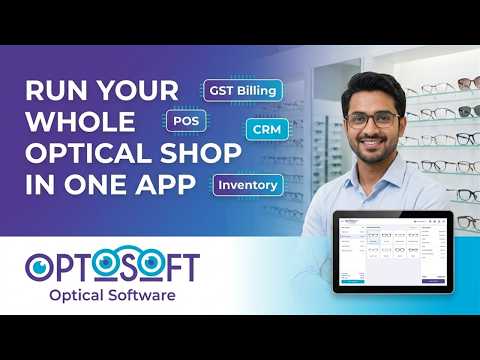
See OptoSoft in Action
Related Reading
- Optical Billing Software in India — GST Invoicing (2026) — the billing side in depth.
- Optical Inventory Management Software (2026) — barcode stock control.
- OptoSoft Features — the complete optical feature set.
- Free Android Mobile POS App — run the counter from a phone.
Frequently Asked Questions — Optical POS Systems
What is an optical POS system?
An optical POS (point-of-sale) system is software that runs the front counter of an optical shop. It combines GST billing, prescription (Rx) lookup, barcode inventory, customer records and payment collection in one screen, so an optician can bill, pull a spectacle or contact-lens power, check stock and take payment in a single workflow. Unlike a generic retail till, it understands lens powers and links every sale to the customer’s prescription.
How is an optical POS different from normal billing software?
Normal retail billing software treats every item as a generic SKU. An optical POS is built optical-first: it stores spectacle lens powers and contact-lens parameters, links prescriptions to invoices, handles frame and lens catalogues, automates eye-test recall and refill reminders, and applies the correct HSN codes for frames, lenses and sunglasses on GST invoices.
How much does an optical POS system cost in India?
Cloud optical POS systems in India typically cost between ₹2,400 and ₹40,000 per store per year depending on features and vendor. OptoSoft is ₹6,000 per store per year with unlimited users and includes GST billing, prescription management, barcode inventory, CRM and a free Android mobile POS app, with no per-invoice or per-module charges.
Is there an optical POS system available outside India?
Yes. OptoSoft is used by optical retailers internationally. Tax handling is configurable for local VAT or sales tax instead of GST, and the international plan is USD 399 per store per year with the same billing, prescription, CRM, inventory and Android mobile POS features as the India plan.
Can an optical POS system run on a mobile phone?
Yes. OptoSoft includes a free Android mobile POS app that lets staff bill, scan barcodes with the phone camera, look up prescriptions and check stock from a phone or tablet. It works as the main counter for a small shop or as a second billing point during busy hours, with no extra hardware.
Does an optical POS handle GST and HSN codes?
A proper optical POS for India produces GST-compliant invoices with the CGST/SGST or IGST split applied automatically and the correct HSN codes for spectacle frames, lenses and sunglasses. OptoSoft maps HSN codes to products so every optical invoice is compliant without manual lookup.